Evincepub Publishing
Longest Gor Tandas in Anciant and Medieval World - Banjaras Links To Iran,Israel and West & The Byzantine Bridge Theory Context
Longest Gor Tandas in Anciant and Medieval World - Banjaras Links To Iran,Israel and West & The Byzantine Bridge Theory Context
Couldn't load pickup availability
Author : Dr.Lalith Kumar Dharavath
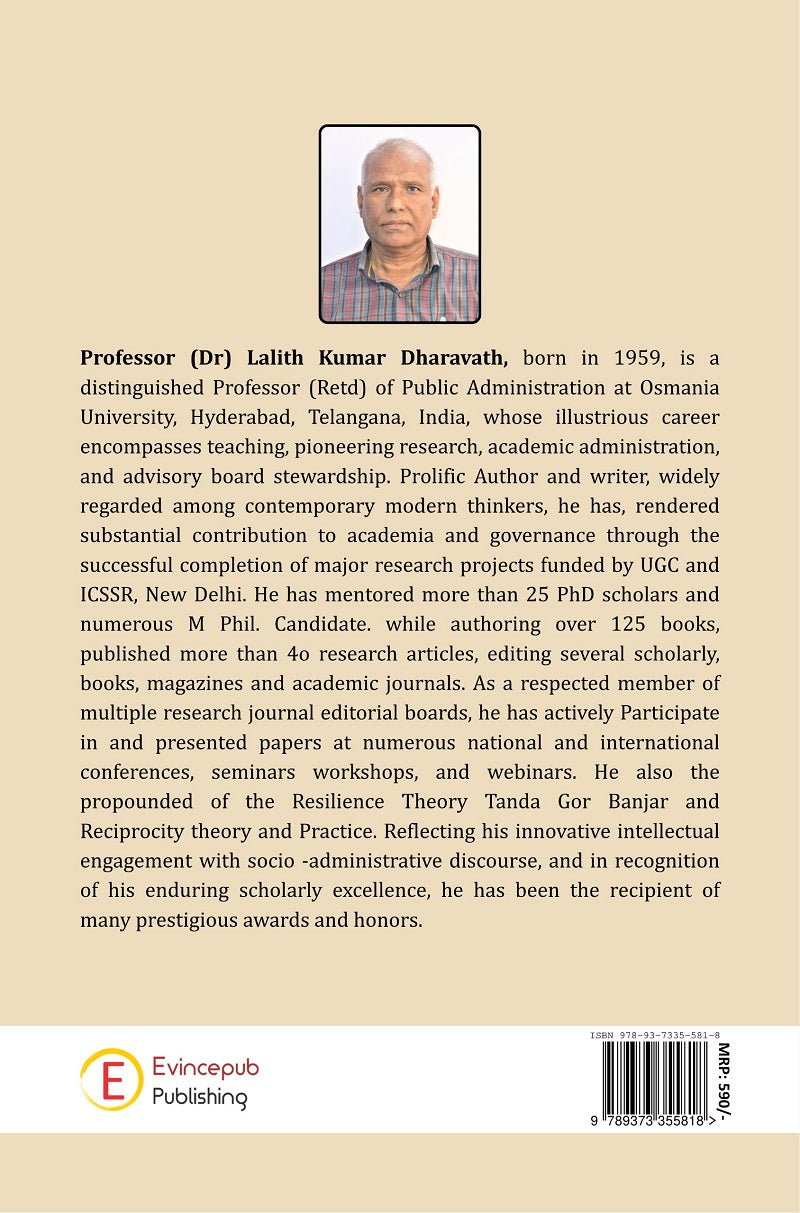
The Byzantine Bridge Theory generally refers to the Byzantine Empire acting as a cultural and geographic bridge between the East (Persia/India) and the West (Europe) during the medieval period. Many historians investigate the theory that the Banjara (Gor) people are linked to the Roma (Gypsies) of Europe, suggesting a long-distance migration path from India through Iran (Persia) and the Byzantine territories into the West. Dr. Lalith Kumar Dharavath is a distinguished Professor (Retired) of Public Administration at Osmania University, Hyderabad. While he has authored over 125 books on the Banjara community, the specific title you mentioned appears to be a segment or subtitle from his extensive research on Banjara origins and migrations. Dr. Dharavath’s work meticulously reconstructs the history of the Gor Banjara, identifying them not merely as a regional tribe but as a global nomadic civilization. Central to his thesis is the "Byzantine Bridge Theory," which posits that the Byzantine Empire served as a critical corridor for Banjara migrations from India to the West during the medieval period. He explores the "Longest Gor Tandas" (caravans), documenting their historical trade routes that linked the Indian subcontinent to Iran (Persia), Israel, and Europe. His research bridges the gap between vibrant oral traditions (Gor Boli) and archaeological evidence. He argues that the Banjara are the ancestral stock of the European Roma (Gypsy) populations, tracing shared linguistic and cultural markers across the Middle East. By examining the community’s role in ancient and medieval trade—acting as vital logistics providers for empires—Dharavath elevates the Tanda from a simple settlement to a sophisticated socio-economic unit that facilitated cross-continental cultural exchange. His work ultimately advocates for the preservation of this "endangered" heritage against the pressures of modern sedentary life.***
Share